
Workspaces and channels
A rail of communities, text channels, and voice channels. Members, presence, and a thread that groups messages the way a busy room expects.
Privacy-first chat
Anzen is an end-to-end encrypted app for workspaces, channels, and direct messages. Your phone locks every message with quantum-proof encryption (ML-KEM-1024) before it is sent.
iOS TestFlight · Android testing · Desktop coming soon
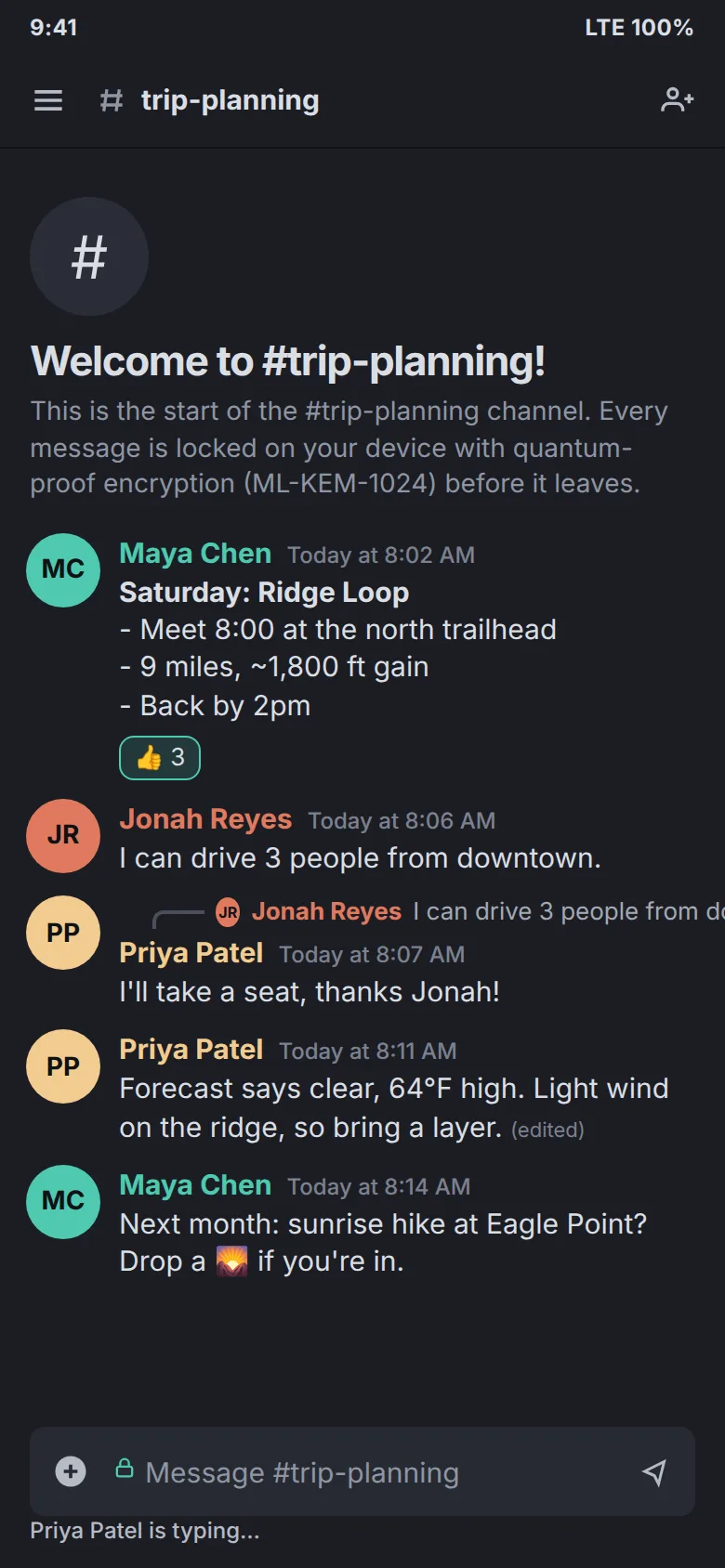
Channels, voice, files, roles, and sign-in are all in the app today. Nothing on this page is a roadmap item.
A rail of communities, text channels, and voice channels. Members, presence, and a thread that groups messages the way a busy room expects.
A private thread with anyone who already shares a workspace with you. Same encryption as a channel. Invites can travel inside a direct message.
Audio goes device to device with encrypted call audio (DTLS-SRTP). Speaking indicators light a green ring from the audio level. The server only keeps track of who is in the channel.
Attach from Photos, Camera, or Files. Each file has its own key inside the encrypted message. JPEG, PNG, and WebP pictures lose location and camera details on your device before upload.
Start with owner, admin, manager, and member. The owner can turn on custom roles with colors, a hoist flag, and a permission set.
No password. A new device needs an email code and a passkey or authenticator. Later, Anzen asks for the authenticator code first. Phones can also unlock with Face ID or a fingerprint.
Quantum-proof encryption (ML-KEM-1024) is how Anzen shares a secret that is designed to stay safe even if quantum computers get good at breaking today’s public-key math. Authenticated encryption (AES-256-GCM) is the lock on the message itself.
01
The message, the reply, the edit, and the reaction never leave as text.
02
Quantum-proof encryption (ML-KEM-1024) wraps a random key for each member. Authenticated encryption (AES-256-GCM) hides the message itself.
03
It can deliver the envelope. It cannot open it. A new phone opens history only with the recovery key you saved.
People in a voice channel connect directly. The call audio is encrypted (DTLS-SRTP). Anzen relays the call setup, not the sound. Speaking indicators light a green ring around whoever is talking.
Free rooms hold up to 5 people at once. Anzen Plus holds up to 25. That is the size of a direct mesh, where every device sends audio to every other device.
Call setup itself is not end-to-end encrypted. Each pair can compare a 30-digit privacy code to confirm nothing sits between them.
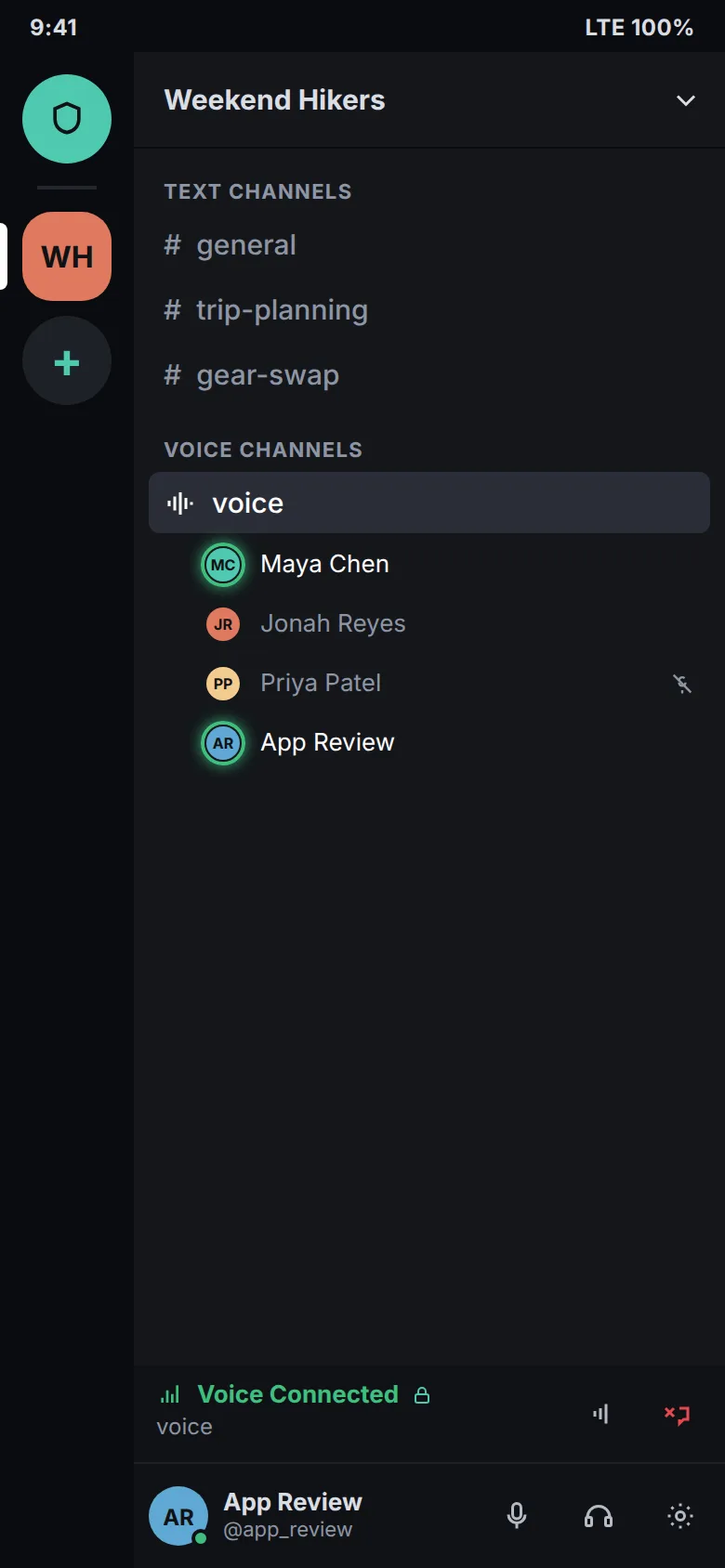
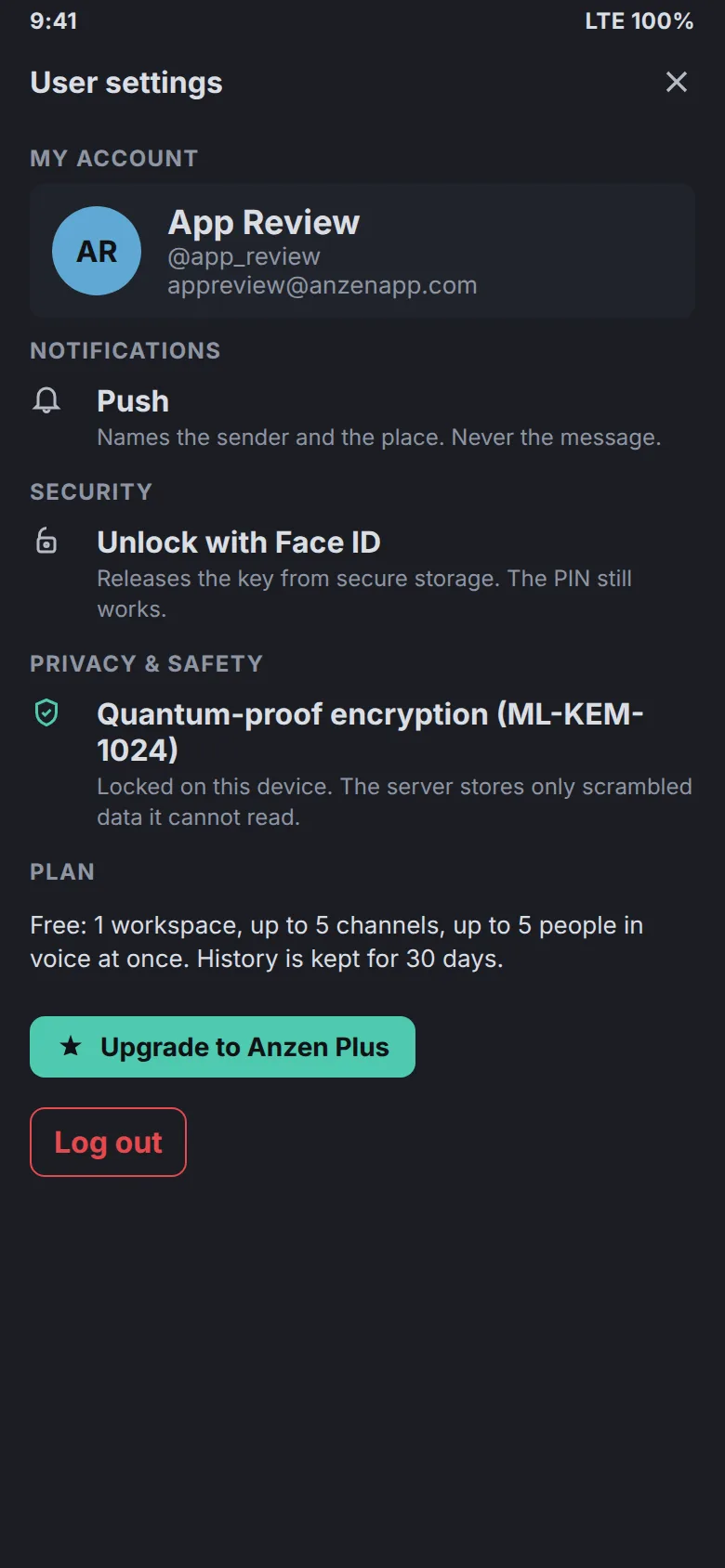
Free: 1 workspace, up to 5 channels, up to 5 people in voice at once. History is kept for 30 days. Plus is a button in the same screen. These pictures are interface mockups of the real client, using the Weekend Hikers review demo, not photos from a signed-in phone.
Both plans use the same encryption. Plus raises the limits. Plus is coming soon, and a price has not been announced.
Free
$0
for the life of the account
One community you own, with the same encryption as Plus.
Anzen Plus
Coming soon
A price has not been announced
More workspaces, larger voice rooms, and a much longer history.
Workspace, channel, and voice limits follow the workspace owner’s plan. Upload size follows the sender. History you can scroll follows your plan, and messages sent by Free accounts are deleted after 30 days.
No. The app encrypts each message on your device before it is sent. The server stores the ciphertext, a nonce, and a key envelope for each recipient. It does not have the keys that open them. A recovery key you keep is what lets a new device open the same history. Anzen cannot recreate that key.
Quantum-proof encryption (ML-KEM-1024). Each account has an ML-KEM-1024 key pair, a post-quantum key encapsulation method standardized by NIST. The app makes a random message key, locks the message with authenticated encryption (AES-256-GCM), and wraps that message key for each member. People without an account key yet get an envelope per device instead. The scheme name on the wire is ML-KEM-1024+AES-256-GCM.
The audio is. Each pair of devices connects directly, and the call audio is encrypted (DTLS-SRTP), so the server cannot hear the call. Call setup is different. The server relays signaling, and that signaling is not end-to-end encrypted. Each pair can read a 30-digit privacy code. If both people see the same code, nothing is sitting between them.
Free: 1 workspace, up to 5 channels, up to 5 people in voice at once. History is kept for 30 days, and messages and files can be up to 5 MB. You can still be a member of workspaces other people own. Workspace, channel, and voice limits follow the owner’s plan. Upload size follows the sender’s plan. Rooms you already have stay as they are when a limit changes.
Plus is coming soon, and a price has not been announced. Anzen Plus: 50 workspaces, up to 200 channels, up to 25 people in voice at once. History is kept for 10 years, and messages and files can be up to 8 MB.
There is no password. Anzen emails a one-time code, then you add an authenticator app or a passkey. A new device needs both. After the trust window, the next check is authenticator-first. A device PIN seals the keys, and a phone can unlock with Face ID or a fingerprint. This website cannot sign you in. Account management here is a placeholder.
When push is turned on for a build, the notification names the sender and the channel or workspace. It does not contain the message. The push provider therefore sees who messaged a device and when. You can mute a workspace, a direct message, or everything. Mutes are applied before a notification is sent.
Not as a download yet. The same client is built for Windows, macOS, and Linux, and public desktop builds are still coming soon. Today Anzen is available to testers on iOS through TestFlight and on Android through Google Play testing.
Anzen is in testing on iPhone and Android. Desktop downloads are coming soon. Sign-in happens in the app, not on this website.